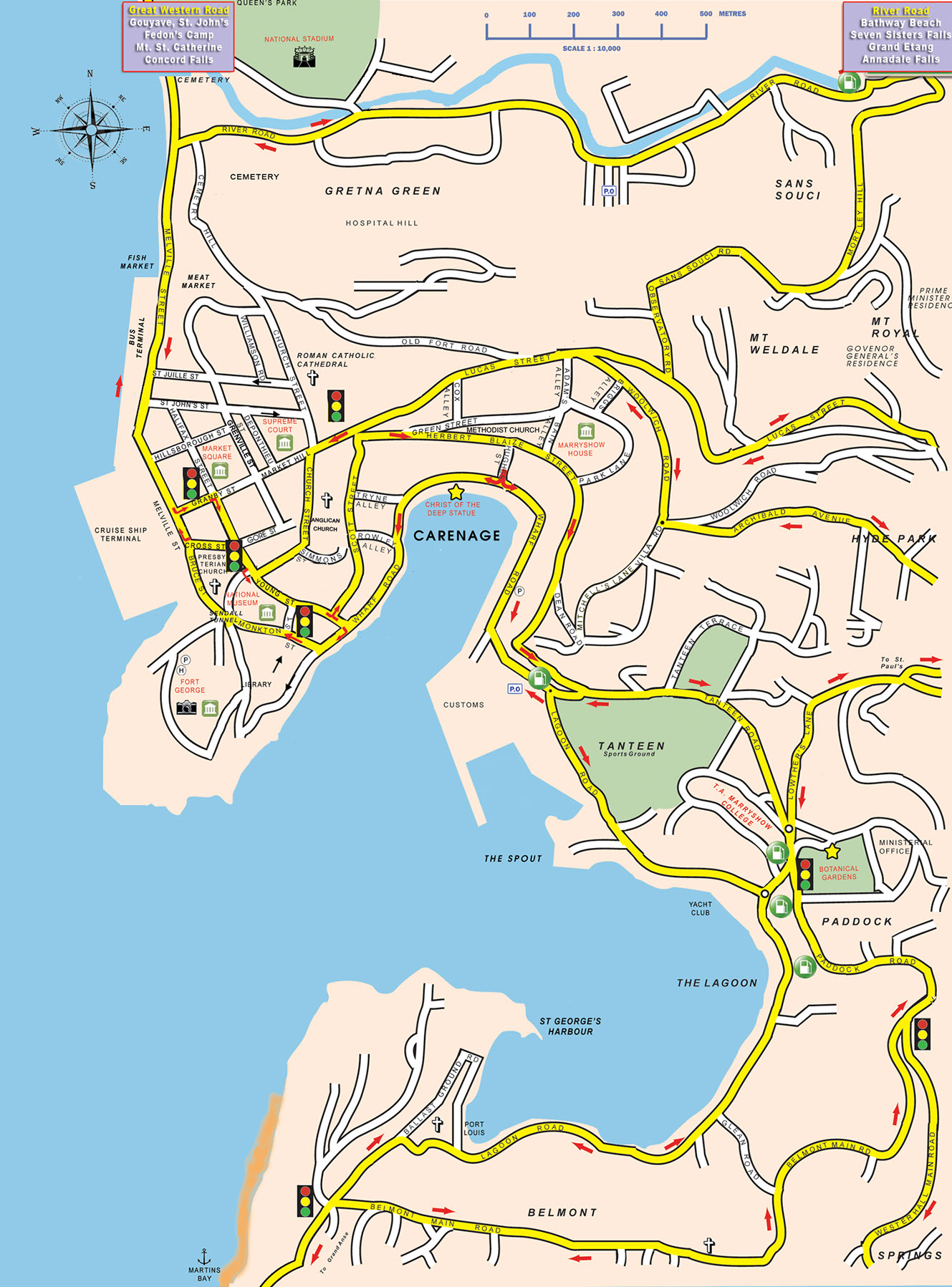

St. George's Map
Use our interactive map to locate hotels, restaurants and places of interest. Click on logo & red dot for more info.
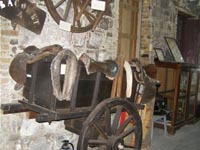 Grenada Museum
Built by the French in 1704 as an Army
Baracks is located at the corner of
Young Street It was then used as
a female prison until 1880 and later as a warehouse. Now displays relics of Grenadian culture, artefacts and history from Pre-Amerindian to present.
 Fort George
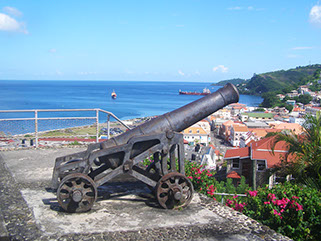
Where cannons are symbols of
Grenada’s embattled past stands proudly at the entrance on Grand Etang Road to protect the city’s harbour. Now home to police headquarters. The revolutionary leader and prime minister, Maurice Bishop and some of his cabinet were executed in 1983 here.


A Walking Tour of St. George's
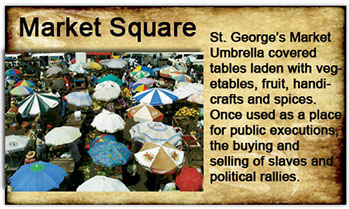
The best way to see St. George’s, Grenada capital is on foot. And there is no better place to start than the Market Square. This popular market is in the heart of Grenada’s commercial centre. The market square were once used as a place for public executions, trading slaves, political speeches today farmers and spice vendors sell their produce in abundance to locals and visitors. In the market you won’t find more tropical fruits and vegetables any where else. Examine all the different herbs and spices grown on the island.
St. George’s, the Carenage has one of the most beautiful harbours in the Caribbean, a perfect horseshoe shape, gives the visitor their first sight of paradise. Some of the street names originated from the colonial administrators ruling at the time. Gore Street refers to Lieutenant-General Gore and Governor General Robert Melville (Melville Street). The Marquis of Granby, (Granby Street) John Manners, was a famous and popular English General who distinguished himself during the Seven Years War in Germany. He retired from the army after the Treaty of Paris in 1763 just when Grenada passed into British hands for the first time and the street was named in his honour.
Sendall Tunnel named after Governor Walter J Sendall in 1889. The tunnel was constructed to connect the Market square.
Grenada’s National Museum on Young Street is situated at the corner of Young and Monckton Streets. Built in 1704 by the French, is one of the oldest structures in the town of St. George and some of the walls formed part of an army barracks. Later in the century, the British used it as a prison until the Richmond Hill prison was built. The Museum houses artifacts from Carib times up to present and a rich collection of Grenada’s history.
Christ of The Deep Monument, the Italian Cruise liner, “Bianca ‘C’, accidentally caught fire and sank in the St. George’s harbour in 1961. A statue entitled “ Christ of the Deep” stands prominently on the harbour commemorating the courage of the Grenadian people who saved the lives of the passengers on board the vessel.
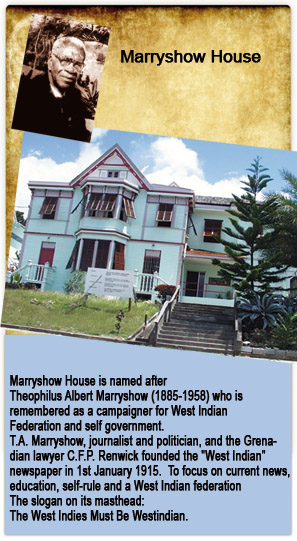
Above the market in Church Street stands the Roman Catholic Cathedral, dating back to 1884. On the opposite side is Parliament Building together with the Supreme Court. Lower down on your left is the Anglican Church (1825) and on the other side of Church Street, on Grand Etang Road is the Presbyterian Church. Many historical buildings were damaged during the passage of Hurricane Ivan on September 7th 2004. Marryshow House the residence of Theophilus Albert Marryshow (1885-1958) who is remembered as a campaigner for West Indian Federation and self government from Great Britain. Fort George, Grenada’s oldest fort was established by the French in 1705 and is the centerpiece of the St George’s skyline.You can explore the dank tunnels and climb to the top to see the cannons and bird’s-eye views.
A plaque in the parade ground marks the spot where revolutionary leader Maurice Bishop was executed, which led to the US invasion in 1983.


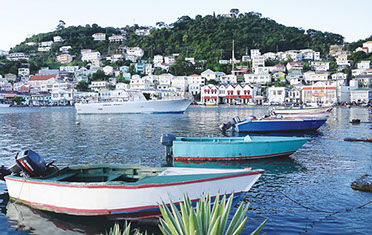 The Carenage
Voted the prettiest harbour in the Caribbean. Take a relaxing stroll along the waterfront and view yachts and fishing boats.

Our Travel Guide
Voted most "Eco Friendly"